Medically reviewed by Dina Mohammed, MD · Last updated: October 5, 2026
Our Specialists for Acute Ischemic Stroke (Large-Vessel Occlusion)
UChicago Medicine is a Comprehensive Stroke Center with 24/7 endovascular coverage. The cerebrovascular and endovascular neurosurgeons below perform mechanical thrombectomy around the clock and partner with vascular neurology, neurocritical care, and neuroradiology to move eligible patients from door to reperfusion as quickly as possible.
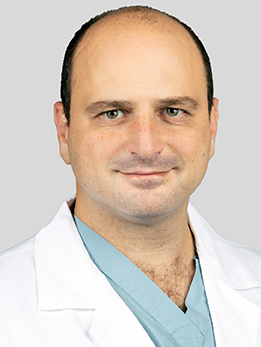
Dr. Doron is a dual-trained cerebrovascular and endovascular neurosurgeon whose research on door-in-door-out transfer times for thrombectomy patients shaped how hub-and-spoke stroke networks move patients to reperfusion faster (Interventional Neuroradiology, 2024). At UChicago he performs stent-retriever and aspiration thrombectomy around the clock for anterior and posterior LVO stroke.
Dr. Zakaria is a cerebrovascular and endovascular neurosurgeon on the UChicago 24/7 stroke call team, performing mechanical thrombectomy for acute large-vessel occlusions and treating the aneurysms, carotid disease, and intracranial stenosis that often sit upstream of them.
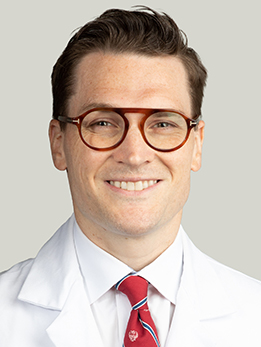
Dr. Polster is a fellowship-trained cerebrovascular neurosurgeon at UChicago whose clinical practice spans aneurysms, AVMs, cavernous malformations, and acute stroke intervention (Journal of Neurosurgery, 2019). He is part of the neuroendovascular team that covers thrombectomy call for Chicago’s South Side Comprehensive Stroke Center.
What Is an Acute Ischemic Stroke from Large-Vessel Occlusion?
A stroke happens when blood flow to part of your brain is suddenly cut off. Without oxygen, brain cells start dying within minutes. About 87% of strokes are ischemic, meaning they are caused by a clot blocking an artery rather than by bleeding. Of those ischemic strokes, roughly one in three involves a large-vessel occlusion (LVO) — a clot stuck in one of the main arteries feeding the brain.
Large-vessel strokes carry the highest risk, as they can obstruct blood flow to a significant portion of brain tissue abruptly, often resulting in death or permanent impairment. Encouragingly, modern techniques like mechanical thrombectomy — a procedure that removes the clot via a catheter — can greatly influence the outcome of these strokes.
Stroke doctors talk about “time is brain” for a reason: with every minute of an untreated LVO, about 1.9 million neurons die. But they also talk about “tissue is brain”: some patients still have brain cells that are starving but not yet dead even many hours later, and modern imaging can find them. That is why patients who would have been sent home untreated ten years ago are now leaving the hospital walking and talking today.
At a Glance
- A large-vessel occlusion (LVO) is a stroke caused by a clot blocking one of the big arteries that supply the brain, and it is the kind of stroke most likely to cause major disability
- Mechanical thrombectomy uses a catheter threaded from the groin or wrist up into the brain artery to physically remove the clot
- Eligible patients can be treated up to 24 hours from when they were last known well if imaging shows brain tissue that is still salvageable
- IV clot-busting medication (tPA or tenecteplase) is given first when the patient qualifies; thrombectomy is done in addition, not instead
- UChicago Medicine is a Comprehensive Stroke Center with a 24/7 neuroendovascular team ready to treat LVO strokes at any hour
Do you have imaging related to Acute Ischemic Stroke (Large-Vessel Occlusion)?
A specialist familiar with Acute Ischemic Stroke (Large-Vessel Occlusion) can review your available studies and records, often within 24 hours.
What Does It Feel Like?
Stroke symptoms appear abruptly. They typically do not cause pain, which is why they can be so perilous—people often delay seeking help, thinking it might go away. It won't. The quicker you reach a hospital equipped with a stroke team, the better your chances of a positive outcome.
The BE FAST warning signs
- B — Balance: sudden trouble with balance, coordination, or dizziness
- E — Eyes: sudden blurred, double, or lost vision in one or both eyes
- F — Face: one side of the face droops when you smile
- A — Arm: one arm drifts down when you try to hold both up
- S — Speech: slurred, garbled, or nonsensical speech; trouble understanding others
- T — Time: call 911 right away and note the time symptoms started
Symptoms that suggest a large-vessel occlusion
LVO strokes tend to cause more severe, combined symptoms because they knock out a big piece of brain at once:
- Complete weakness or paralysis of one side of the body
- Inability to speak or to understand speech (aphasia)
- Looking or turning forcefully to one side (gaze deviation)
- Ignoring one side of the world entirely (neglect)
- In basilar artery strokes: sudden coma, crossed weakness, severe imbalance, or “locked-in” symptoms
If you see any of these, call 911 immediately. Do not drive yourself. Paramedics can pre-notify the stroke team and route you to a Comprehensive Stroke Center like UChicago Medicine, where thrombectomy is available around the clock.
How Is It Diagnosed?
The process for diagnosing a stroke is designed for rapid response. As soon as you arrive, a timer begins, and a well-coordinated team from the ER, neurology, neurosurgery, radiology, nursing, and pharmacy works simultaneously rather than one after the other.
Non-contrast CT scan
The initial scan ensures there is no bleeding in the brain, as bleeding and clotting strokes appear alike externally but require different treatments. If no blood is detected and your symptoms suggest a stroke, you may qualify for clot-busting medication.
CT angiogram (CTA)
A quick injection of contrast dye lets us see every major brain artery on the CT scanner. This is where we find the large-vessel occlusion — a clot stuck in the internal carotid artery, the middle cerebral artery (M1 or M2 branches), or the basilar artery at the back of the brain. Finding an LVO is what triggers the thrombectomy pathway.
Perfusion imaging (CTP or MRI)
This is the technology that changed stroke care. Perfusion scans show two things: the core (brain tissue that is already dead) and the penumbra (brain tissue that is starving but still alive and salvageable if we restore blood flow quickly). A small core with a large penumbra — what stroke doctors call a mismatch — is a green light for thrombectomy even 6, 12, or up to 24 hours after symptoms began. Without this imaging, those late-presenting patients would be sent home. With it, many of them walk out of the hospital.
NIH Stroke Scale (NIHSS)
Alongside imaging, the team scores your neurological exam on a 0–42 scale. A score of 6 or higher combined with an LVO on imaging generally meets criteria for thrombectomy.
Types of Large-Vessel Occlusion
Where the clot is lodged determines which part of your brain is at risk and which approach the neuroendovascular team will use to reach it.
Anterior circulation LVO (the front of the brain)
- Internal carotid artery (ICA): the biggest, most devastating strokes. The clot is often at the top of the carotid where it branches into the middle and anterior cerebral arteries (a “T occlusion”).
- Middle cerebral artery, M1 segment: the most common LVO. Causes severe weakness and, depending on which side, either language problems or neglect.
- Middle cerebral artery, M2 segment: a smaller branch inside the sylvian fissure. Still treatable with thrombectomy, though the technical challenge is higher.
Posterior circulation LVO (the back of the brain and brainstem)
- Basilar artery occlusion: a clot in the main artery that feeds the brainstem. Without treatment, basilar strokes are frequently fatal or leave patients in a “locked-in” state. Two randomized trials in 2022 (ATTENTION and BAOCHE) confirmed that thrombectomy up to 12–24 hours after onset roughly doubles the chance of good functional recovery.
- Vertebral artery occlusion: often treated when it threatens the basilar artery downstream.
Anterior and posterior LVOs present and behave differently, but the core treatment principle is the same: find the clot fast, open the vessel, and protect whatever brain tissue still has a chance.
How Is It Treated?
IV thrombolysis — alteplase (tPA) or tenecteplase
If you arrive within about 4.5 hours of your last known well time and you do not have a condition that makes bleeding too risky, the stroke team will give you a clot-busting drug through an IV. For decades the standard drug has been alteplase (tPA); many centers, including UChicago, now use tenecteplase, a newer agent that is given as a single fast push and has been shown to work as well or better before thrombectomy. IV thrombolysis does not replace thrombectomy for large-vessel clots — it is a first punch that sometimes helps soften the clot before the catheter goes in.
Mechanical thrombectomy — pulling the clot out
For significant blockages in large vessels, thrombectomy is the main treatment. The patient, under conscious sedation or light anesthesia, is treated by a neuroendovascular surgeon who inserts a thin catheter through a small incision in the groin (femoral artery) or wrist (radial artery). The catheter is then guided up to the aorta and into the blocked artery in the brain. Two specialized tools, often used in tandem, are employed to remove the clot.
- Stent retriever: a self-expanding mesh that unfurls inside the clot, traps it like a fishing net, and is then pulled back out through the catheter
- Aspiration catheter: a large-bore catheter that sucks the clot out directly using vacuum, sometimes called the “direct aspiration” or ADAPT technique
Most UChicago cases use a combined approach. The goal is TICI 2b or 3 reperfusion — meaning more than half, or ideally all, of the blocked territory has been reopened. Higher TICI scores are directly tied to better patient outcomes.
The extended window — 6 to 24 hours
Until 2018, thrombectomy was only offered in the first 6 hours. Two landmark trials changed that. The DAWN trial showed that patients presenting 6–24 hours after last known well benefit dramatically when perfusion imaging shows a small core and a large penumbra. The DEFUSE-3 trial extended the window to 16 hours using similar mismatch criteria. Together, these two studies mean that wake-up strokes and patients who could not get to the hospital immediately are now routinely treated successfully at UChicago.
After the procedure
Patients recover in a dedicated neurocritical care unit, usually for 24–48 hours. Blood pressure, glucose, and swallowing are managed intensively. The team searches for the cause of the stroke — atrial fibrillation, carotid narrowing, a heart defect — so that the next stroke can be prevented. Most patients then transition to inpatient stroke rehabilitation.
Planning treatment for Acute Ischemic Stroke (Large-Vessel Occlusion)?
Your Acute Ischemic Stroke (Large-Vessel Occlusion) records can be discussed by the appropriate specialists so the recommendation reflects the full case.
What Are the Outcomes?
Before mechanical thrombectomy existed, about 15–20% of patients with a severe large-vessel stroke could live independently 90 days later. After the 2015 thrombectomy trials — MR CLEAN, ESCAPE, EXTEND-IA, SWIFT PRIME, and REVASCAT — that number roughly doubled. Two things drive a good outcome: how complete the reperfusion is (TICI score) and how fast it happens (time from onset to reopened artery).
| Factor | Independent at 90 days (mRS 0–2) | What to know |
|---|---|---|
| No thrombectomy (medical only) | ~19% | Pooled control arm from HERMES |
| Thrombectomy, any TICI | ~46% | Pooled thrombectomy arm from HERMES |
| Thrombectomy, TICI 2b/3 reperfusion | ~50–60% | Substantial reperfusion drives outcome |
| Thrombectomy, TICI 3 (complete) reperfusion | ~60–70% | Best-case scenario |
| Extended window 6–24h (DAWN) | 49% vs 13% medical | Mismatch-selected patients |
| Basilar artery occlusion (ATTENTION) | ~46% mRS 0–3 vs 23% medical | Life-saving for a once-uniformly-fatal stroke |
Every 30 minutes saved from onset to reperfusion adds about a 10% absolute gain in the chance of a good outcome. That is why stroke systems of care, door-to-puncture times, and a 24/7 neuroendovascular team matter as much as the device inside the catheter. UChicago Medicine’s Comprehensive Stroke Center is built around that clock.
References
Have Questions About Stroke Care?
Call the department to discuss Acute Ischemic Stroke (Large-Vessel Occlusion), request a case review, or plan an appointment.
Schedule: (773) 702-2123